
Little P.Eng. Engineering for Belt Feeders Engineering Design, 3D Modeling & Engineering Drawings Across USA and Canada

Reliable belt feeder engineering design is essential for achieving controlled, consistent, and efficient material flow in mining, aggregate, cement, power generation, fertilizer, chemical processing, ports, terminals, and other bulk material handling facilities. Little P.Eng. Engineering provides specialized Belt Feeders engineering design, 3D modeling, and engineering drawings across the USA and Canada, supporting new installations, equipment upgrades, plant expansions, and retrofit projects.
Professional Belt Feeder Engineering Design
Belt feeders are designed to withdraw bulk material at a controlled rate from bins, silos, hoppers, stockpiles, and storage systems before transferring it to conveyors, crushers, screens, mills, or processing equipment. Unlike conventional belt conveyors, feeders can operate under significant material head pressure and require careful consideration of loading conditions, material behavior, belt tensions, drive requirements, and structural loads.
Little P.Eng. Engineering evaluates critical design parameters such as required feed capacity, belt width and speed, material density, particle size, surcharge conditions, hopper geometry, skirt configuration, loading pressure, friction, drive power, pulley arrangement, take-up requirements, and support structure loads.
Our engineering approach focuses on developing belt feeder systems that provide dependable material withdrawal while minimizing problems such as uncontrolled flow, belt overload, excessive wear, material leakage, spillage, and equipment downtime.
Bulk Material Flow and Feeder Performance

Successful belt feeder design begins with understanding the characteristics of the bulk material being handled. Coal, iron ore, limestone, potash, fertilizer, aggregates, biomass, sand, minerals, and other materials can behave very differently during storage and discharge.
Little P.Eng. Engineering considers important material properties including:
Bulk density and particle size distribution
Moisture content and material variability
Internal and wall friction
Abrasiveness and wear potential
Flowability and potential for arching or ratholing
Required feed rate and operating conditions
Where advanced evaluation is required, Discrete Element Modeling (DEM) can be incorporated to study material movement, loading patterns, transfer behavior, segregation, impact zones, and equipment interaction. This provides valuable engineering insight for optimizing feeder and hopper geometry.
Belt Feeder Mechanical and Structural Engineering
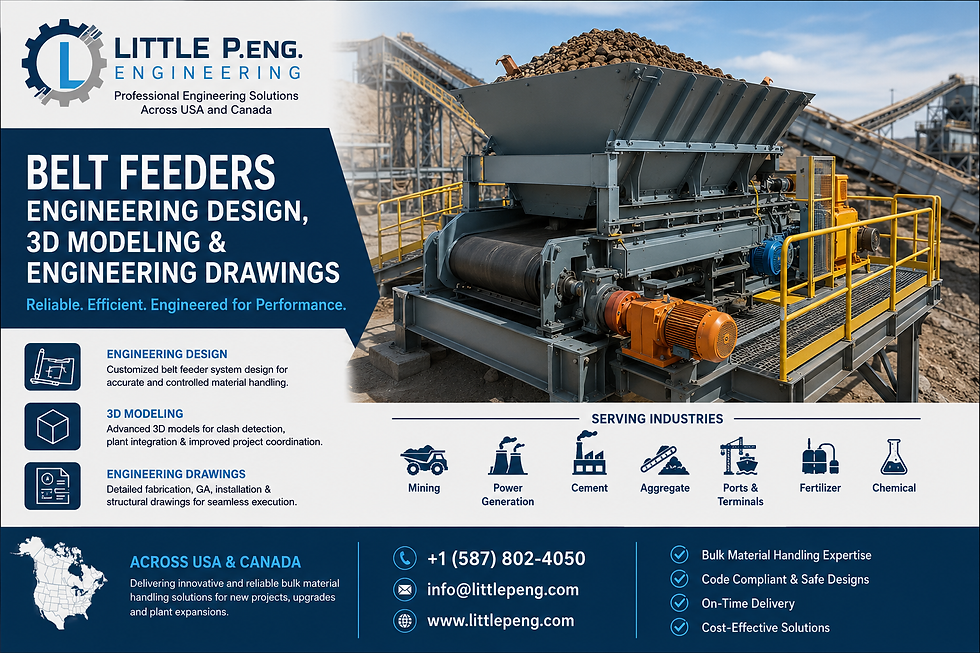
A belt feeder is an integrated mechanical and structural system. Proper engineering must consider not only belt capacity but also the forces transferred to the supporting steelwork, foundations, hopper, pulleys, shafts, bearings, and drive components.
Little P.Eng. Engineering can develop calculations and engineering solutions for belt tensions, drive loads, pulley reactions, equipment supports, structural framing, platforms, access systems, connections, and foundations.
Structural design can incorporate applicable project requirements and standards used throughout the United States and Canada, including AISC, CSA, ASCE, IBC, and NBCC, as applicable to the project location and scope. Wind, seismic, dead, live, operational, maintenance, and equipment loads can be considered when required.
Belt Feeder 3D Modeling
Modern bulk material handling projects benefit significantly from accurate 3D engineering models. Little P.Eng. Engineering provides detailed 3D modeling of belt feeders and their surrounding equipment to improve coordination between mechanical, structural, piping, electrical, and plant-layout disciplines.
3D models can incorporate the belt, pulleys, drive assembly, hopper interface, skirts, guards, structural supports, platforms, walkways, chutes, and adjacent conveyors. Modeling helps identify interference and access problems before fabrication and construction, reducing costly field modifications.
For brownfield projects, 3D modeling is especially valuable where a new belt feeder must fit within an existing plant with limited available space.
Fabrication and Engineering Drawings
Little P.Eng. Engineering develops comprehensive belt feeder engineering drawings suitable for project coordination, fabrication, installation, and construction. Depending on project requirements, deliverables may include:
General arrangement drawings
Equipment layouts and sections
Belt feeder structural drawings
Hopper and chute interface drawings
Steel framing and connection details
Platforms, stairs and access arrangements
Foundation and equipment support drawings
Mechanical arrangement drawings
Fabrication and installation details
3D models and coordinated engineering packages
Clear engineering drawings help fabricators, contractors, equipment suppliers, and facility owners understand the design intent and execute projects efficiently.
Belt Feeders for New and Existing Facilities
Little P.Eng. Engineering supports both greenfield and brownfield bulk material handling projects. Services can include completely new belt feeder installations as well as capacity upgrades, replacement feeders, structural modifications, hopper changes, equipment relocation, and integration with existing conveyor systems.
For existing facilities, engineering can evaluate current equipment geometry and loading conditions to determine practical modifications while minimizing disruption to plant operations.
Belt Feeder Engineering Across USA and Canada
Little P.Eng. Engineering provides bulk material handling engineering services across the USA and Canada, supporting mining operations, processing plants, terminals, manufacturing facilities, power plants, cement facilities, aggregate operations, and industrial material handling systems.
By combining belt feeder engineering design, structural engineering, bulk material flow analysis, 3D modeling, and detailed engineering drawings, Little P.Eng. Engineering provides clients with an integrated approach from initial concept through fabrication and construction.
Whether your project requires a new belt feeder, hopper discharge system, feeder replacement, capacity increase, structural upgrade, 3D plant model, or fabrication drawing package, Little P.Eng. Engineering delivers practical engineering solutions focused on safety, reliability, maintainability, and long-term performance.
Little P.Eng. Engineering – Your Engineering Partner for Belt Feeders, Bulk Material Handling Systems, 3D Modeling, and Engineering Drawings Across the USA and Canada.
#BeltFeeders #BeltFeederDesign #BeltFeederEngineering #BulkMaterialHandling #BulkMaterialHandlingEngineering #MaterialHandling #MaterialHandlingEngineering #ConveyorEngineering #ConveyorDesign #BeltConveyors #IndustrialEngineering #MechanicalEngineering #StructuralEngineering #EngineeringDesign #3DModeling #EngineeringDrawings #FabricationDrawings #BulkSolids #MaterialFlow #MaterialFlowEngineering #MiningEngineering #MiningIndustry #AggregateIndustry #CementIndustry #PowerGeneration #ChemicalProcessing #FertilizerIndustry #PortsAndTerminals #IndustrialDesign #PlantEngineering #HopperDesign #ChuteDesign #FeederDesign #DEMAnalysis #DiscreteElementModeling #ConveyorSystems #USAEngineering #CanadaEngineering #ProfessionalEngineering #LittlePEngEngineering

