
Little P.Eng. Engineering for Bulk Material Handling Pipe Racks Engineering Design, 3D Modeling & Engineering Drawings Across USA and Canada

Little P.Eng. Engineering provides specialized bulk material handling pipe rack engineering design, structural analysis, 3D modeling, and detailed engineering drawings across the USA and Canada. From mining and mineral processing facilities to cement plants, power generation, chemical processing, terminals, manufacturing plants, and industrial material handling systems, our engineering approach focuses on safety, structural reliability, constructability, and efficient integration with surrounding equipment.
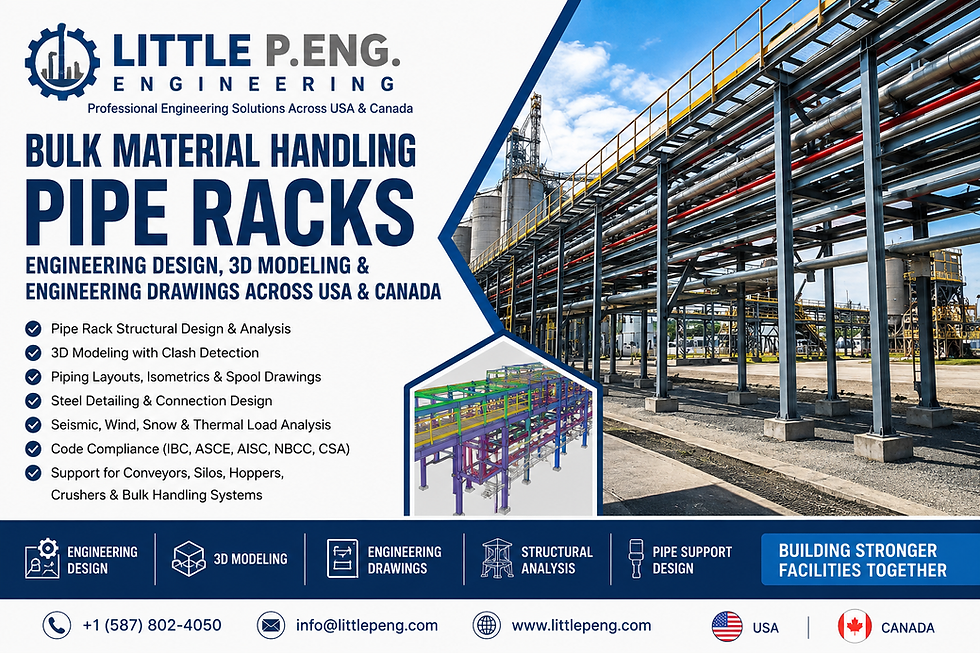
Pipe Rack Engineering for Bulk Material Handling Facilities
Pipe racks in bulk material handling plants frequently serve more functions than conventional process piping support. They may support process piping, utility piping, cable trays, electrical systems, instrumentation, maintenance platforms, access walkways, chutes, dust collection ductwork, and equipment connections while interacting with conveyors, transfer towers, crushers, feeders, silos, bins, and other structures.
Little P.Eng. Engineering develops pipe rack systems considering the complete facility layout and applicable design loads. Engineering can include steel framing, columns, beams, bracing systems, base plates, anchor bolts, foundations, equipment supports, pipe supports, platforms, stairs, and structural connections.
Our designs account for applicable loading conditions such as:
Dead and operating loads
Pipe and equipment loads
Thermal piping forces
Wind loading
Snow and environmental loading
Seismic forces
Maintenance and platform live loads
Cable tray and electrical loads
Dynamic equipment effects where applicable
Future piping and expansion allowances
This integrated approach helps prevent structural conflicts and provides a practical framework for supporting the complex mechanical and material handling systems found in modern industrial facilities.
Structural Analysis and Code-Compliant Engineering
Bulk material handling pipe racks require careful evaluation of both strength and serviceability. Excessive movement can affect piping systems, equipment connections, conveyors, ductwork, and other interconnected components.
Little P.Eng. Engineering performs detailed structural analysis to evaluate member strength, stability, deflection, drift, bracing requirements, connection forces, foundation reactions, and support loads.
Depending on project location and requirements, engineering may incorporate applicable provisions of IBC, ASCE 7, AISC, NBCC, CSA standards, and other governing provincial, state, municipal, or project-specific requirements.
For piping-intensive facilities, structural engineering can also be coordinated with piping stress analysis using CAESAR II or Bentley AutoPIPE, helping transfer calculated pipe support reactions into the pipe rack structural model. This coordination is particularly important for large-diameter piping, high-temperature systems, seismic applications, and piping systems generating significant anchor or guide forces.
3D Modeling for Pipe Racks and Material Handling Systems
Modern industrial projects benefit significantly from coordinated 3D engineering models. Little P.Eng. Engineering provides 3D modeling to develop practical pipe rack layouts while coordinating structural framing with piping, conveyors, equipment, platforms, electrical systems, and other plant components.
3D modeling allows engineers and project teams to identify potential clashes before fabrication and construction. The model can be used to coordinate:
Pipe routing – structural steel – pipe supports – cable trays – access platforms – equipment – conveyors – transfer structures – maintenance clearances.
For piping projects, AutoCAD Plant 3D can be incorporated into the engineering workflow to support piping layouts, equipment arrangements, piping isometrics, and spool development.
A coordinated model can reduce costly field modifications while improving fabrication accuracy and installation efficiency.
Detailed Engineering and Fabrication Drawings
Little P.Eng. Engineering can transform engineering calculations and 3D models into comprehensive engineering and construction drawings suitable for project coordination, fabrication, procurement, and installation.
Typical deliverables may include:
Pipe rack general arrangement drawings
Structural framing plans
Elevations and sections
Steel member layouts
Bracing details
Connection details
Base plate and anchor bolt details
Pipe support details
Platform and access details
Foundation loading information
3D model views
Piping layouts
Isometric drawings and spool drawings
Engineering drawings are developed with attention to practical fabrication and field installation requirements, helping bridge the gap between analysis, design, and construction.
Integration with Bulk Material Handling Equipment
Pipe racks rarely operate as isolated structures. In a bulk handling facility, they must be coordinated with the overall material flow system.
Little P.Eng. Engineering provides engineering support for facilities involving belt conveyors, feeders, hoppers, bins, silos, crushers, screens, transfer towers, stackers, reclaimers, ship loaders and unloaders, wagon and truck loading systems, dust collection equipment, storage facilities, and associated industrial structures.
This multidisciplinary capability allows pipe rack engineering to be developed as part of the complete plant rather than as an independent structure.
Engineering Across the USA and Canada
Projects throughout North America encounter different environmental loads, seismic conditions, building codes, owner specifications, and operational requirements. Little P.Eng. Engineering supports industrial projects across the United States and Canada, developing engineering solutions appropriate for the project's location and governing requirements.
Whether the project involves a new bulk material handling facility, plant expansion, additional process piping, structural modification, equipment upgrade, or rehabilitation of an existing pipe rack, our engineering services can support projects from concept through detailed design.
Why Choose Little P.Eng. Engineering?
Little P.Eng. Engineering combines bulk material handling engineering, structural engineering, piping stress analysis, seismic engineering, 3D plant modeling, and detailed engineering drawings within a coordinated engineering workflow.
Our objective is to deliver pipe rack systems that are safe, efficient, constructible, code-compliant, and properly integrated with the complete industrial facility.
For mining, power generation, cement, chemical, oil and gas, manufacturing, processing, terminals, and other heavy industrial facilities, Little P.Eng. Engineering provides bulk material handling pipe rack engineering design, 3D modeling, structural analysis, and engineering drawings across the USA and Canada—supporting projects from initial layout and calculations through detailed drawings and construction-ready engineering.
#PipeRackDesign #PipeRackEngineering #BulkMaterialHandling #BulkMaterialHandlingEngineering #StructuralEngineering #IndustrialEngineering #EngineeringDesign #3DModeling #EngineeringDrawings #StructuralDesign #PipeSupportDesign #PipingEngineering #PipingDesign #PipeStressAnalysis #IndustrialStructures #SteelStructureDesign #SteelDetailing #PlantDesign #PlantEngineering #MaterialHandling #ConveyorEngineering #ConveyorDesign #MiningEngineering #MiningIndustry #ProcessPlantDesign #IndustrialDesign #MechanicalEngineering #CivilEngineering #StructuralAnalysis #SeismicDesign #SeismicEngineering #ASCE7 #AISC #NBCC #CSA #EngineeringUSA #EngineeringCanada #EngineeringServices #LittlePEng #LittlePEngEngineering

